
How to Master the Long Line Recall: The Path to Off-Leash Freedom
If you want a dog that comes back every single time, you need more than just a pocket full of treats—you need coordination. A reliable recall is built on three specific components working together: your long line, your body language, and your reward strategy.
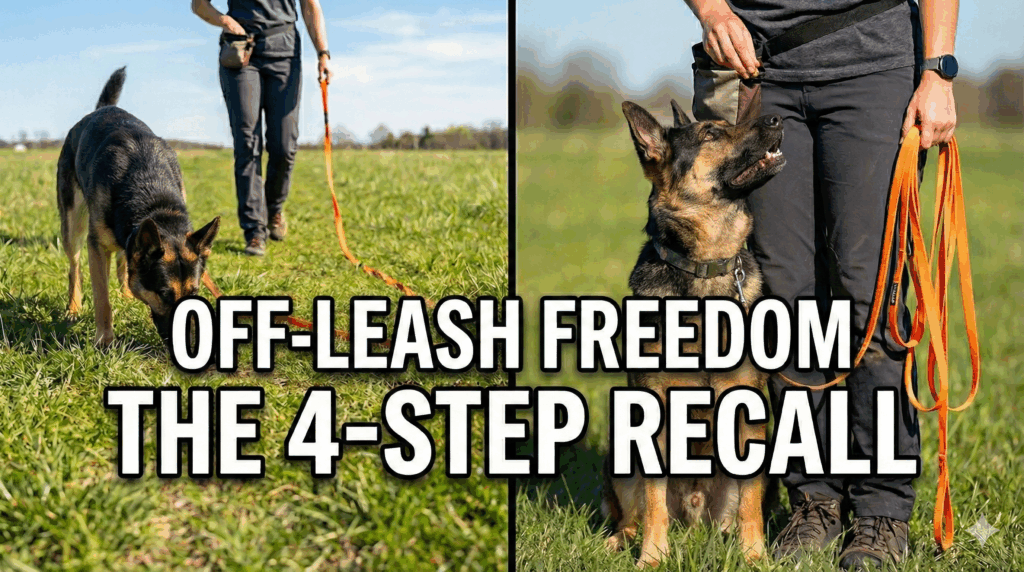
It’s not terribly difficult, but it does require practice to ensure you aren’t getting tangled up or sending mixed signals to your dog2222. In the video above, I break down exactly how to manage a 15-foot line and the specific mechanics that turn a “maybe” recall into a “must” recall.
The Gear: Why Length Matters
For this training, I prefer a 15-foot long line. Anything shorter than 8 feet doesn’t give enough freedom, and a 30-foot line can be a lot to handle for beginners.
Pro Tip: I put knots in my long line. These act as tactile cues so I know exactly where my dog is on the line without having to constantly look down at my hands.
Don’t Get “Stuck in the Mud”
The biggest mistake I see novices make is reeling the line in while their feet are planted in one spot. We call this getting “stuck in the mud”.
To do this correctly, you must pair your reeling motion with walking backwards. Using your full arm span to manage the line prevents tangles, while moving backward invites the dog into your space.
The Reward Bubble
Where you feed your dog is just as important as what you feed them. A common error is reaching out to bring the reward to the dog. Don’t do that.
You need to create a “bubble” right in front of you. You want the dog to come all the way into that space to get paid. If you reach out, you are rewarding them for stopping short. Wait until the dog settles in that bubble, then deliver the food down the center.
The 4-Step Formula
If you take nothing else away from this video, memorize the four steps of communication we use for every repetition:
Cue: The verbal command (“Come”) .
Pressure: The sensation on the leash (or later, the remote collar).
Release: The moment the dog turns toward you, the pressure stops.
- Reward: The payment for completing the job.
Watch the full video above to see a live demonstration with Moose, where we start with food lures and transition to using the remote collar for a finished, off-leash ready dog.